Blogs
Supreme Court Quashes ₹425.27 Cr Penalty Over AI-Hallucinated Citations: A Watershed Moment for Adjudication Integrity and Commercial Litigation
Supreme Court Quashes ₹425.27 Cr Penalty Over AI-Hallucinated Citations: A Watershed Moment for Adjudication Integrity and Commercial Litigation
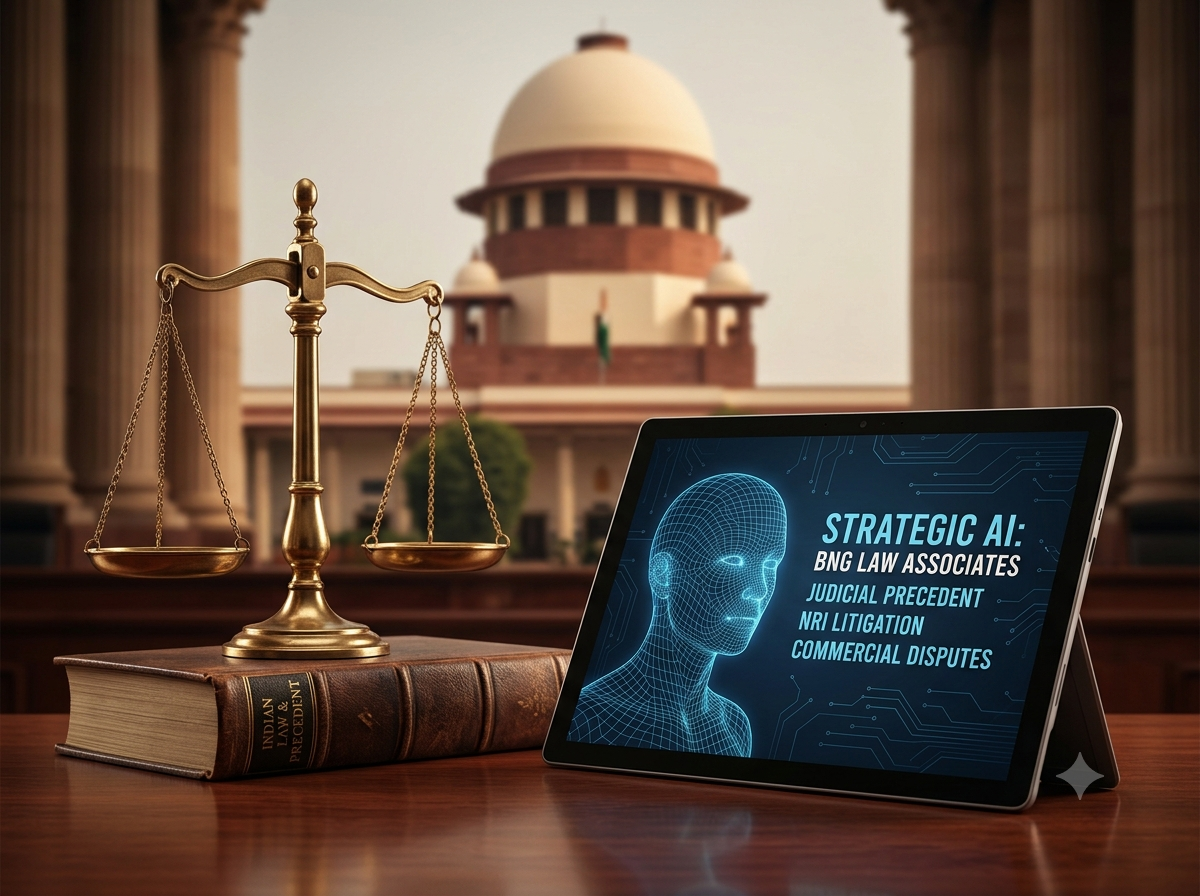
Introduction: When Algorithms Threaten Judicial Precedent In commercial arbitration, revenue disputes, and multi-jurisdictional property litigation, citations are not mere formatting formalities—they represent the bedrock of judicial precedent and due process. A division bench of the Hon’ble Supreme Court of India (Justice Dipankar Datta and Justice Sheel Nagu) delivered a landmark ruling in Vijay Ghanshyam Gadiya v. Union of India & Anr. [2026 LiveLaw (SC) 884 / Civil Appeal arising out of SLP (C) No. 15605 of 2026]. The Apex Court set aside a staggering customs penalty of ₹425,27,99,100 (~₹425.27 Crore) after discovering that the quasi-judicial adjudicating authority had anchored its adverse findings on fictitious, non-existent, and AI-hallucinated judicial precedents. The Apex Court delivered a definitive institutional warning: "AI may well serve as training wheels, but entrusting it with the pilot's seat would be both imprudent and dangerous... Assistance can never be substituted for adjudication." Factual Matrix: The ₹425 Crore Diamond Export Penalty The Order-in-Original: The dispute arose from an Order-in-Original dated October 8, 2025, passed by the Additional Commissioner of Customs, Surat. The authority alleged misdeclaration of natural diamonds as lab-grown diamonds under Section 114 of the Customs Act, 1962, imposing an individual penalty of ₹425.27 Crore on the appellant. The High Court Challenge: The Gujarat High Court initially dismissed the statutory challenge on January 20, 2026, leading to a Special Leave Petition before the Supreme Court. The Discovery of AI Hallucinations: Before the Supreme Court, counsel for the appellant exposed that multiple case laws, regulatory articles, and judicial authorities relied upon by the customs authority in the penalty order were either entirely non-existent or cited propositions never laid down by the courts. Independent Judicial Verification: The Supreme Court independently verified each citation cited in the order and found that the adjudicating officer had fallen prey to AI-generated hallucinations. Reaffirming principles earlier recognized in Pooja Ramesh Singh v. Jammu & Kashmir Bank Ltd., the Court held that reliance on dubious and phantom precedents was fatal to the legality of the penalty order. The Apex Order: The Supreme Court quashed both the Gujarat High Court’s order and the Order-in-Original, remitted the matter for de novo adjudication before a different officer of equivalent rank, and left it to the disciplinary authority to evaluate appropriate administrative action against the author of the defective order. Strategic Analysis for Boards, CXOs, and Litigants 1. The Fatal Vulnerability of Unverified Citations in Quasi-Judicial Orders Whether defending transfer pricing adjustments, customs classifications, enforcement actions under PMLA/FEMA, or complex corporate arbitrations, an adjudicator cannot issue adverse findings on speculative or unverified authority. Corporate legal teams must scrutinize show-cause notices and orders-in-original for synthetic citations or distorted legal ratios. 2. Technology as an Auxiliary Tool vs. Adjudicative Substitute While Large Language Models (LLMs) and generative algorithms can accelerate semantic organization and discovery, the analytical task of statutory interpretation remains strictly human. Entrusting substantive reasoning to generative engines risks procedural invalidation. 3. Safeguards for High-Net-Worth Individuals & Cross-Border Stakeholders For overseas corporate entities, Foreign Portfolio Investors (FPIs), and Non-Resident Indians (NRIs) managing substantial assets or family trusts across India, disputes frequently hinge on statutory interpretation and precise procedural adherence. Engaging a panel-grade firm with dedicated courtroom presence ensures every submission, writ petition, or appellate paper-book undergoes rigorous verification. The Institutional Standard at BNG Law Associates At BNG Law Associates, our practice combines 15+ years of seasoned courtroom advocacy with panel-grade research protocols. Backed by experience representing major public enterprises, financial institutions, and global HNIs, we operate on three pillars: Strict Citation Verification: Every authority cited across our pleadings in the Supreme Court of India, Delhi High Court, NCLT, NCLAT, and District Courts is cross-checked through primary law reporters (SCC, SCR, DLT) and official court records. Remote Advisory for Global Clients: We provide structured video consultations (via Microsoft Teams and Zoom) for NRIs and multinational corporations requiring strategic litigation without cross-border travel. Full-Spectrum Commercial & Civil Defense: From multi-crore revenue penalties to high-stakes commercial disputes and NRI property partitions, our firm provides strategic legal solutions tailored to complex jurisdictions. Regulatory Disclaimer (BCI Rule 36) This publication is issued by BNG Law Associates solely for legal awareness, scholarly evaluation, and public information. It does not constitute an advertisement, solicitation, or legal advice under the Bar Council of India Rules. Readers should obtain independent legal counsel before acting upon any information contained herein. Official Portal: www.bnglawassociates.com Chambers & Practice Desk: New Delhi / Delhi NCR (PAN-India Representation & NRI Advisory)